The honest comparison
Twelve specific differences.
No marketing language. No aerial drone B-roll. Every claim lands at a specific year, partnership, or place. For hunters and families who've done the homework on three other outfitters and want a fourth honest answer.
Why this page exists
You’ve probably already opened three other outfitter sites in adjacent tabs.
Every guided-hunt website in Colorado says some version of “experience the hunt of a lifetime in the heart of the Rockies.” That language is meaningless. It doesn’t help you book a week. It doesn’t help you tell three operations apart.
Below is what we think actually differentiates Elk Glade — twelve specific, falsifiable, named-source claims. Read them, compare them against the other outfitter tabs you have open, and decide which combination fits your week.
The twelve
Specific. Falsifiable. Sourced.
01A founding 1888 ranch, run by a family rooted here since 1929.
The Rathke Ranch was founded in 1888 — the valley's original working cattle ranch on the south slope of Pikes Peak. Jim's grandfather homesteaded his own ground here in 1929, and in 2001 brothers Mark and Jim bought the Rathke place and joined the two into one operation. The cattle history on this ground runs back to 1888; the family's, to 1929.
Private ground — no truck traffic on opening day.
In GMU 59, 1st and 4th rifle bull elk are limited entry and 2nd and 3rd rifle are over the counter, but the private and leased ground we hunt sits behind the ranch's own gate. It doesn't see the orange-suit waves and Forest Service two-track convoys of public OTC country. Lower density. More animals on patterns we recognize. Fewer hunters competing for the same bedded bull.
2,100 family-owned acres and over 25,000 leased.
The 2,100 acres of family-owned land and over 25,000 acres of leased land sit in the middle of a contiguous public-land block. We can guide a hunter from a cattle bench on the ranch ground into the BLM canyons in a single morning without ever crossing a fence we don't control. Most outfitters in the unit either run public-land DIY-adjacent or hold a smaller exclusive footprint surrounded by neighbors.
You stay in the working ranch lodge.
Hunts, drives, and stays are based out of the ranch's own lodge — not a tent, not a drop camp, not a chain hotel forty minutes away. Private rooms, hot showers, three ranch meals a day, and a porch that looks straight out over the canyon. Free Starlink reaches within a radius of the ranch house, and an emergency-frequency radio calls straight to Colorado's largest medical-helicopter service — quiet, capable infrastructure behind the old-West calm. It's the building the operation runs from.
One-on-one or two-on-one guide ratios.
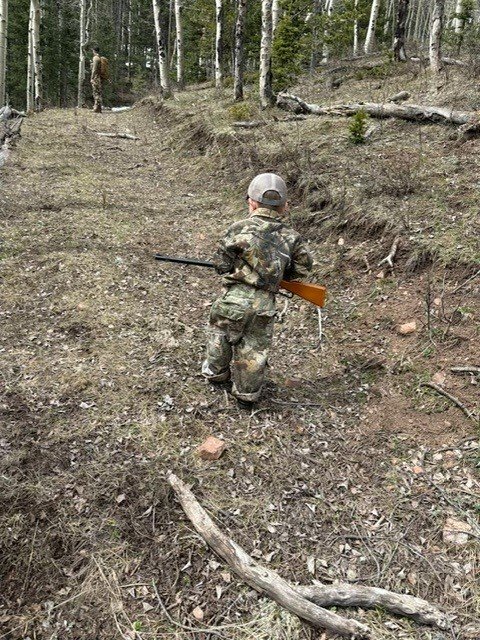
We don't run three-on-one camps. Hunters are paired with a guide who knows the country and stays with them through the week. The math works out because we don't run a high-volume operation — limited tags, limited guests, the same ranch staff for the season. Sixty percent of the guests in a given season have hunted or ridden here before; the ratio and the returning crew are a large part of why they come back.
A working ranch, not a dude ranch.
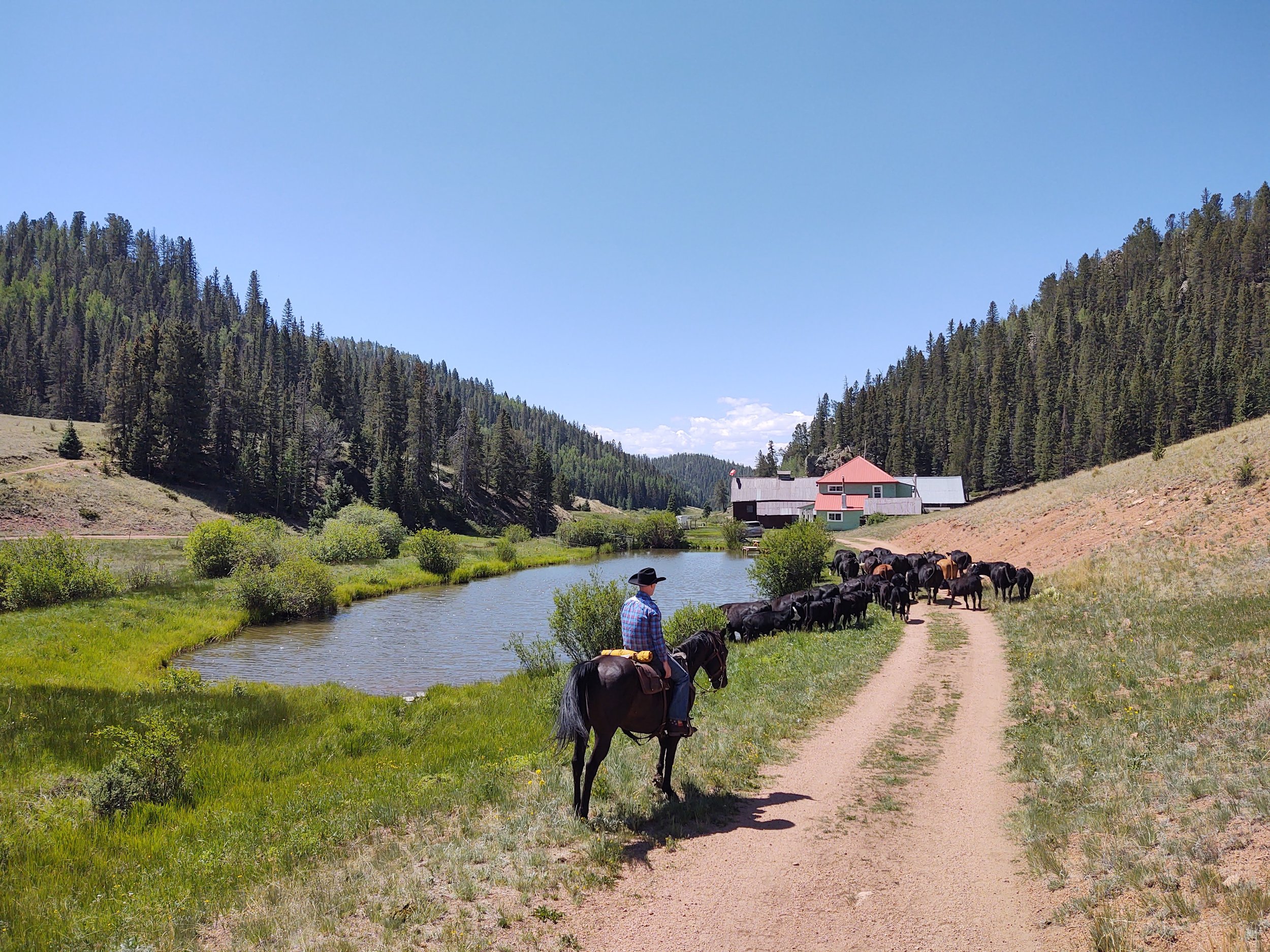
Cattle still graze the ranch — a local rancher's herd, under lease — and the hunts, drives, fishing, and stays are how the family keeps the land whole instead of subdividing or selling out. When you ride a cattle drive here, you're moving real cow-calf pairs to a real summer pasture. The work is the product; the experience is the byproduct.
Cold, year-round water on East Beaver Creek.
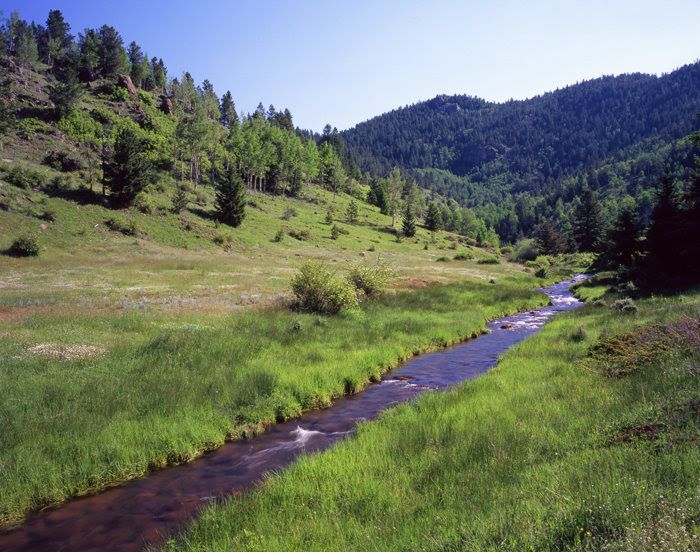
East Beaver Creek runs through the ranch ground, cold and spring-fed and reliable — year-round water in a country where the next meaningful surface water is miles in either direction. It supports the cattle, the fishery, and the wildlife through a dry July when the surrounding country goes hard and brown.
Conservation work is part of the books, not marketing.
Elk Glade earned a Colorado Parks & Wildlife grant for protecting the largest wildlife corridor between New Mexico and Wyoming on the Front Range, and works alongside the Colorado Cattlemen's Agricultural Land Trust, the Western Landowners Alliance, and the Palmer Land Conservancy. Cattle grazing manages fuel loads; conservation-grade fencing supports elk and pronghorn passage. The conservation work funds the cattle work and vice versa.
60 miles from Colorado Springs Airport.
The 90-minute drive from COS is the shortest airport-to-ranch transit of any serious guided operation on the Front Range. Land at noon, sit down to dinner at the lodge. DIA-bound flights work too — the drive is three hours of plains and high-country pavement.
Real pricing transparency where we can give it.
The cattle drive is priced openly and bookable directly through Xola. Hunt pricing varies by tag allocation, weapon, and party size, so we send a line-item quote inside two business days instead of posting a single "from" number that doesn't apply to your week.
The canyon system around the ranch.
The ranch sits inside the largest wildlife corridor between New Mexico and Wyoming on the Colorado Front Range — country whose conservation value Colorado Parks & Wildlife recognized with a grant to Elk Glade. The only road in is the one the ranch built. That's the country your hunt or your ride or your wedding sits inside.
We answer the phone.
Jim Johnson, the operations lead, takes the calls personally at (303) 355-4868. Not a call center, not a booking platform, not a sales rep on commission. The person who answers is the person who will be on the ranch when you arrive.
The lodge
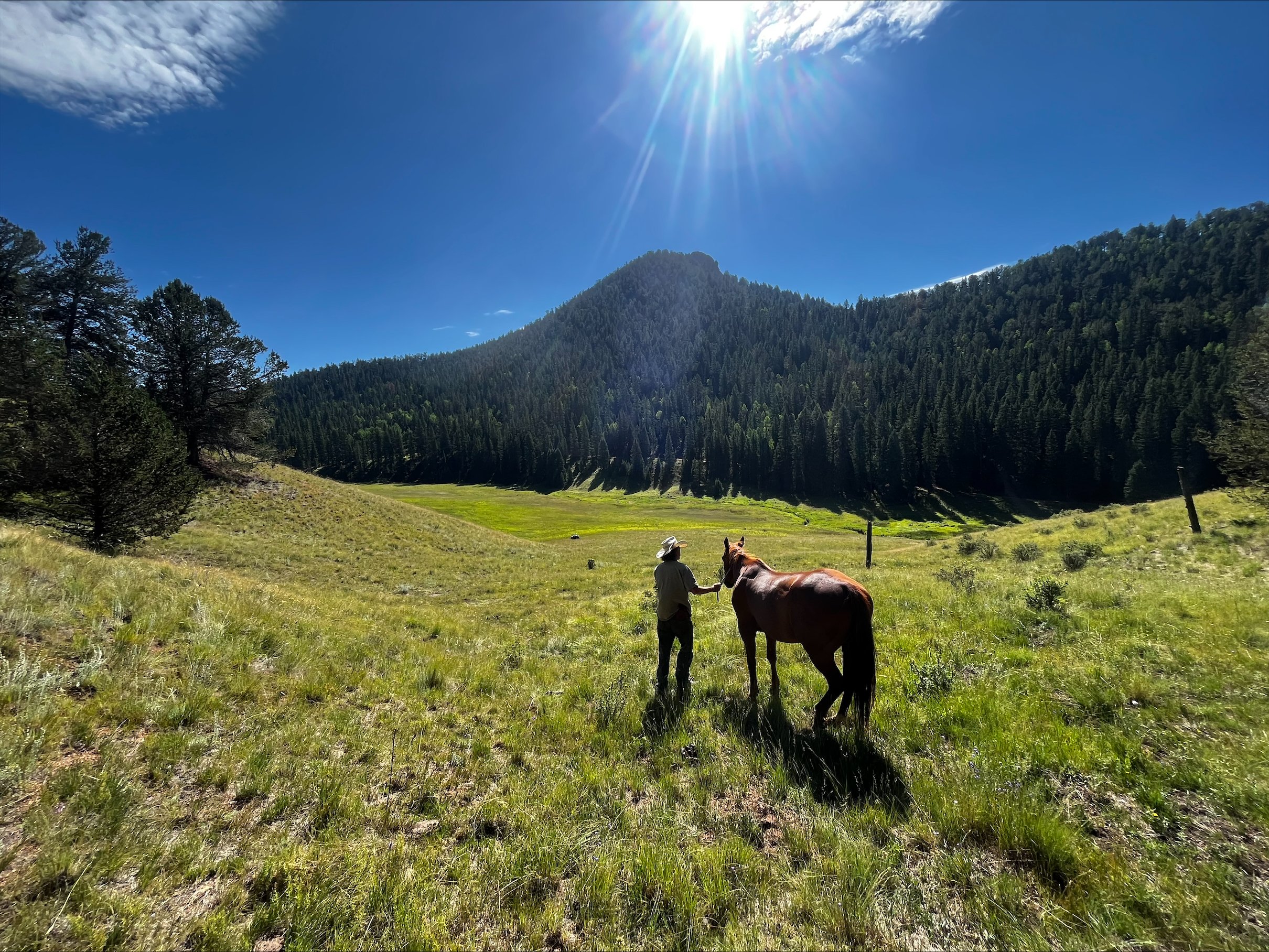
The ranch lodge — private rooms, ranch meals, and the canyon out every window.
In case it helps
What Elk Glade is not.
The clearer comparison sometimes comes from naming what we aren’t. None of the categories below are bad — they’re just different products.
- Not a dude ranch
- Dude ranches are guest-first; cattle and horseback are programming. We are cattle-first; the guest programming exists to support the ranch.
- Not a crowded public-land hunt
- In GMU 59, 1st and 4th rifle bull elk are limited entry (draw) and 2nd and 3rd rifle are over the counter. Either way, you hunt our private and leased ground, not the public-land crowds.
- Not a corporate-owned outfitter
- No private equity, no holding company, no rotating GM. The Johnson family owns and runs the ranch.
- Not a high-volume camp
- We don't book overlapping six-hunter weeks back-to-back. The ranch carries the number of hunters the unit and the lodge actually support.
- Not a luxury resort with guided add-ons
- The lodge is a working ranch lodge; the meals are ranch meals; the floors creak. If you're looking for resort luxury, the Broadmoor is an hour north and we'll happily help you stack the two stays.
Common questions
What hunters and families ask first.
Is Elk Glade a dude ranch?
No. Elk Glade is a working ranch — grazed by a local rancher's cattle under lease — that runs guided hunt, cattle drive, fishing, horseback, and stay programming alongside the ranch work. Dude ranches are designed primarily as guest experiences with cattle as scenery; here the cattle work is real and guests take part in it.
What makes Elk Glade different from other Colorado outfitters?
A founding 1888 cattle ranch run today by the family that homesteaded the valley in 1929, a hunt unit (GMU 59) that is limited entry for 1st and 4th rifle (draw) and over the counter for 2nd and 3rd rifle bull elk, 2,100 acres of family-owned land and over 25,000 acres of leased land, one-on-one or two-on-one guide ratios, and a real working-ranch lodge. The combination is the differentiation; no single piece exists in isolation.
How long has Elk Glade been operating?
The ranch itself — the Rathke Ranch — was founded in 1888. Jim's family homesteaded its own ground in the valley in 1929, and brothers Mark and Jim bought the Rathke place in 2001 and now run it as one working operation: a registered cow-calf cattle ranch with guided hunts, cattle drives, fishing, horseback, and ranch stays.
What is the GMU 59 advantage?
In GMU 59, 1st and 4th rifle bull elk are limited entry and 2nd and 3rd rifle are over the counter. Either way, our remote valley sees virtually no outside hunting pressure beyond our own operations. Lower pressure preserves elk behavior — bulls bed where they always bed, cows water where they always water, and patterning year-over-year actually holds.
How do I book or get a quote?
For the cattle drive, book directly through Xola — $1,495 base for up to 4 guests. For hunts, stays, fishing, weddings, and family weeks, use the live quote builder at /quote (three minutes, PDF inside two business days) or call (303) 355-4868 directly.
If this fits
Send a note. We pick up the phone.
The quote builder takes three minutes and produces a PDF inside two business days. Or call Jim at the ranch directly — the number on this page is the number that rings the kitchen.