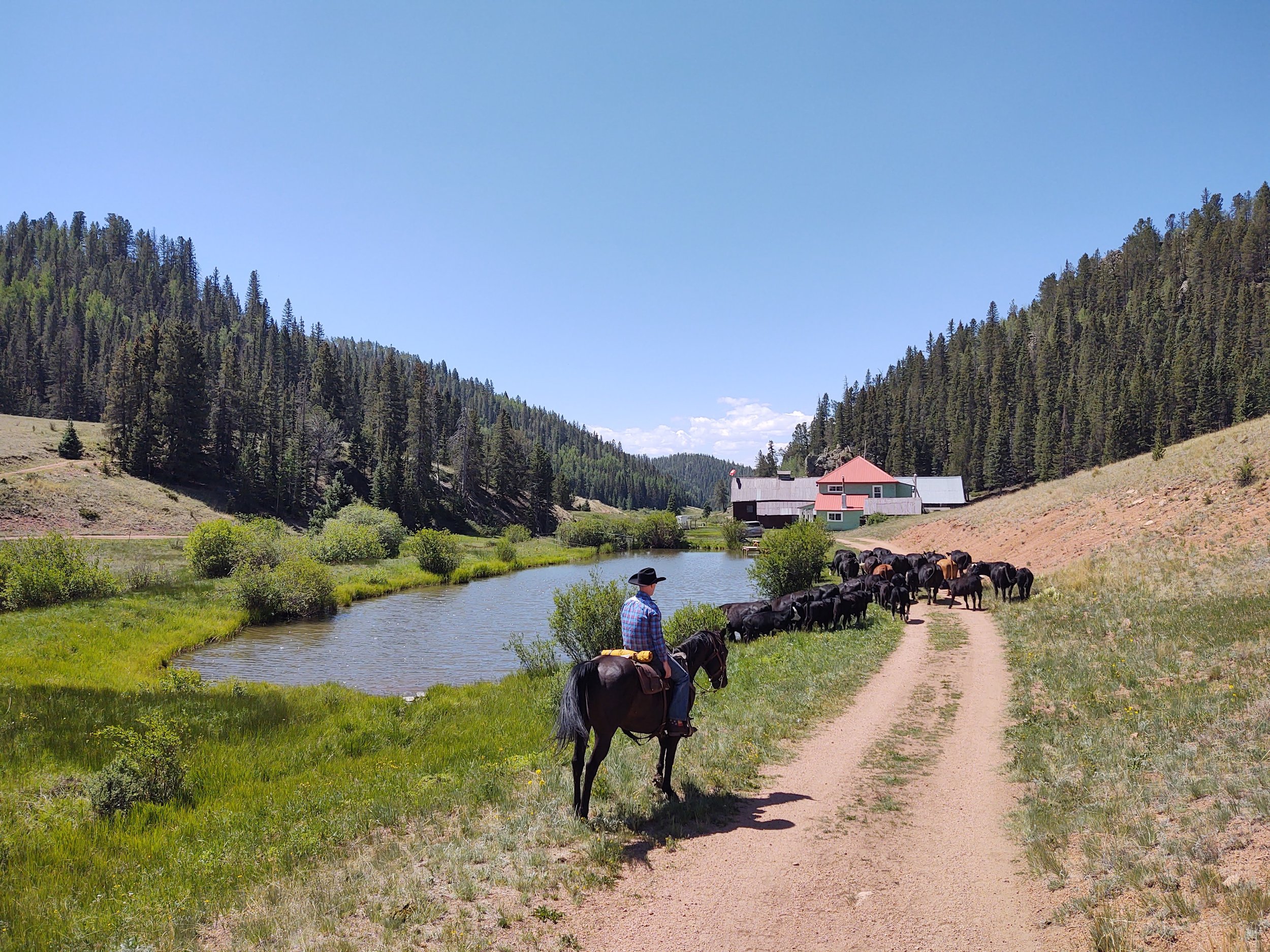
Angus
British (Scotland)Solid black, naturally polled (hornless)
The dominant US beef breed. Prized for marbling and the 'Certified Angus Beef' brand. Hardy, good mothers, easy calving.

Ranching · Cattle breeds
The black cows, the white faces, the big cream-colored ones — a plain-English guide to the breeds you see on Western ranches, what each is bred for, and why the high country favors hardy British cattle and their crosses.
The short version
Almost every beef animal on a Western ranch traces to one of two families. British breeds — Angus, Hereford, Red Angus — are moderate, fertile, hardy, and quick to marble, which makes them the backbone of grass-based ranching. Continental breeds — Charolais, Simmental, Gelbvieh — came out of mainland Europe bred for size and growth.
Most ranches don’t run one purebred herd; they cross. British cows for fertility and easy calving, often a Continental bull to put growth on the calves — or the classic Hereford-on-Angus “black baldy.” Crossbred cattle get “hybrid vigor”: healthier, faster-growing, longer-lived than either parent. That’s why most American beef comes from crosses.
The breeds
Solid black, naturally polled (hornless)
The dominant US beef breed. Prized for marbling and the 'Certified Angus Beef' brand. Hardy, good mothers, easy calving.
Solid red, polled
The same Angus genetics in red — some ranchers prefer red hides for heat tolerance and fewer eye problems in bright country.
Red body, white face and underline
Famously docile and hardy on rough range. Cross a Hereford bull on Angus cows and you get the 'black baldy' — a workhorse of Western ranching.
Large, white or cream
A big-framed terminal breed. Charolais-cross calves grow fast and heavy — used to add pounds to a calf crop.
Large, red-and-white or black
Growth and milk. Often crossed with Angus ('SimAngus') to blend Continental size with British marbling and fertility.
Reddish-gold or black
Muscle, fertility, and milk. Another Continental breed used in crossbreeding programs for growth.
Lean, varied colors, sweeping horns
Extreme hardiness, longevity, and easy calving. More a heritage and crossing breed now than a mainstream commercial one.
Frequently asked
Angus is by far the most common beef breed in the United States. Its black hide, strong marbling, easy calving, and the marketing power of the Certified Angus Beef brand have made it the default for commercial cow-calf operations. Most black cattle you see on Western ranches are Angus or Angus crosses.
British breeds — Angus, Hereford, Red Angus — tend to be moderate-framed, fertile, good mothers, and quick to marble, which suits grass-based ranching. Continental breeds — Charolais, Simmental, Gelbvieh — were bred in mainland Europe for size, muscle, and growth. Many ranches cross the two: British cows for fertility and easy calving, a Continental bull to add growth to the calves.
A 'black baldy' is the calf you get from crossing a Hereford with an Angus — typically a black body with a white face. It's one of the most popular crosses in American ranching because it combines Angus marbling and hardiness with Hereford docility and range toughness, and benefits from hybrid vigor (crossbred animals often outperform either purebred parent).
High-country and mountain ranches tend to favor hardy British breeds and their crosses — Angus, Hereford, Red Angus, and black baldies — because they hold condition on rough grass, handle cold and altitude well, calve easily, and travel the country a mountain ranch demands. Continental crosses are added when a ranch wants more growth in its calves. The right breed for any ranch depends on its climate, forage, and market.
Crossbreeding produces 'hybrid vigor' — crossbred calves are often healthier, grow faster, and the crossbred cows are more fertile and longer-lived than purebreds. It also lets a rancher combine traits: the fertility and marbling of British breeds with the growth of Continental ones. Most commercial beef in the US comes from crossbred cattle, not purebreds.