Skip to content

Decision guide · Updated 2026-05-29

OTC vs limited entry. Which one fits?

Honest comparison across eight dimensions plus a 7-row decision matrix mapping your situation to the right access type. Limited entry isn't always the right answer; OTC isn't always the wrong one. The right answer depends on what you optimize for.

The short version

OTC trades success rate for accessibility. Limited entry trades waiting for hunt quality.

Both are real options in Colorado. OTC is what you choose when you need a hunt this year and you’re willing to accept higher hunter density. Limited entry is what you choose when you can plan years ahead and you want the lower-pressure, higher-success-rate experience.

The mistake hunters make is treating the choice as ideological (“public land DIY purist” vs “limited-entry elitist”) when it’s actually situational. Read the eight-dimension comparison below and the 7-row decision matrix; the right answer for your trip will be obvious.

Try it on your points

Draw or OTC — what can you hunt?

Pick your nonresident preference points and see which Colorado units you can hunt over-the-counter this year, which are in reach of the draw, and which are worth building toward — with the 2026 OTC changes baked in.

How many nonresident preference points do you have?

2026 heads-up: Colorado pulled the Gunnison Basin units (54, 55, 551) off OTC into the limited draw, while the White River and Bears Ears units returned to OTC after the 2022–23 winterkill. OTC status moves every year — always confirm with CPW before you count on it.

A starting read, not a guarantee. Point needs are bucketed and approximate, and Colorado’s OTC list + draw odds change every year — verify the current figures with Colorado Parks & Wildlife before you apply. Tap any unit for its full profile.

Eight dimensions

Honest comparison across both columns.

DimensionOTCLimited entry
How you get a tagBuy it. Over the counter, leftover list, or online at CPW. No draw, no wait.Apply for the draw in late March / early April. Wait for results in early summer. May take 1–10+ years of points depending on the unit.
Cost (non-resident)$760.96 license + $9 app + $11.61 habitat stamp = ~$782 total.Same fees PLUS $52 per point if you bank one. Multi-year accumulation can mean $200+ in point fees before you even draw.
Hunter densityHigh in popular units (Routt, Eagle, Pitkin, GMUs along I-70). Truck traffic at every trailhead opening week.Materially lower because CPW caps tags. The whole point of limited entry is hunter management.
Bull-class typicalPressure-conditioned bulls. Mature bulls hold deep timber by day 3. Smaller average antler size due to harvest pressure.Larger average antler class in many units due to age structure. Bulls bed in patterns that hold year-over-year.
Success rate rangeTypically 10–22% statewide for bulls. Public-land DIY lands in the lower half of that range.Typically 20–40%+ depending on unit and weapon. Guided private hunts on limited units run materially above public DIY.
Trip planning frictionLower. You can decide in August to hunt in October.Higher. The application is March; the hunt is October. Trip planning has to live with that timeline.
Country qualityMostly accessible public land along established corridors. Some genuinely remote, much within day-hike of a road.Often the most remote and least-pressured units. Some genuinely roadless. Many in the western and southern reaches.
Best for hunters whoHave schedule flexibility year-to-year. Want low planning friction. Are willing to trade success rate for accessibility.Want a higher-probability hunt and can plan years ahead. Want lower pressure even at the cost of waiting. Have time to build points.

Decision matrix

Pick the row that matches your situation.

Each row maps a specific hunter situation to the right access type and a one-sentence reason. Find your row; the answer should fit.

Your situationPickWhy
You can plan years aheadLimited entryBank points now; the units that need 3–6 points are typically the units that deliver the best hunt.
You can only commit a few months outOTC (or leftover list)Limited-entry timelines don't fit your planning horizon. Choose an OTC unit and commit to public-land DIY tactics.
You want the highest possible success rateLimited entry + guidedThe compound advantage of a low-pressure unit and a guide with year-round patterning is the highest-yield combination available.
You want the lowest costOTC + DIY public landSkip the point fees, skip the outfitter fees, accept the lower success rate. The cheapest viable Colorado elk hunt.
You're a first-time Colorado hunterGuided (OTC or limited)The learning curve on Colorado country is the dominant variable on success. A guide compresses it dramatically; tag access matters less for a first trip.
You want a trophy-class bullLimited entry, premium unitTrophy-class bulls live in low-pressure units with age structure. Premium units take 5+ points to draw; the wait is part of the trophy.
You want a Family & Group Camp weekLimited entry private landParallel programming, lodge accommodation, family weeks — these models exist almost exclusively on private-land limited-entry operations.

Specifically on GMU 59

Draw for 1st and 4th rifle. Over the counter for 2nd and 3rd.

GMU 59 (south slope of Pikes Peak) is limited entry for 1st and 4th rifle bull elk; 2nd and 3rd rifle bull licenses are over the counter. The draw difficulty for the limited seasons is moderate — most non-residents land tags with 1–3 preference points depending on the season.

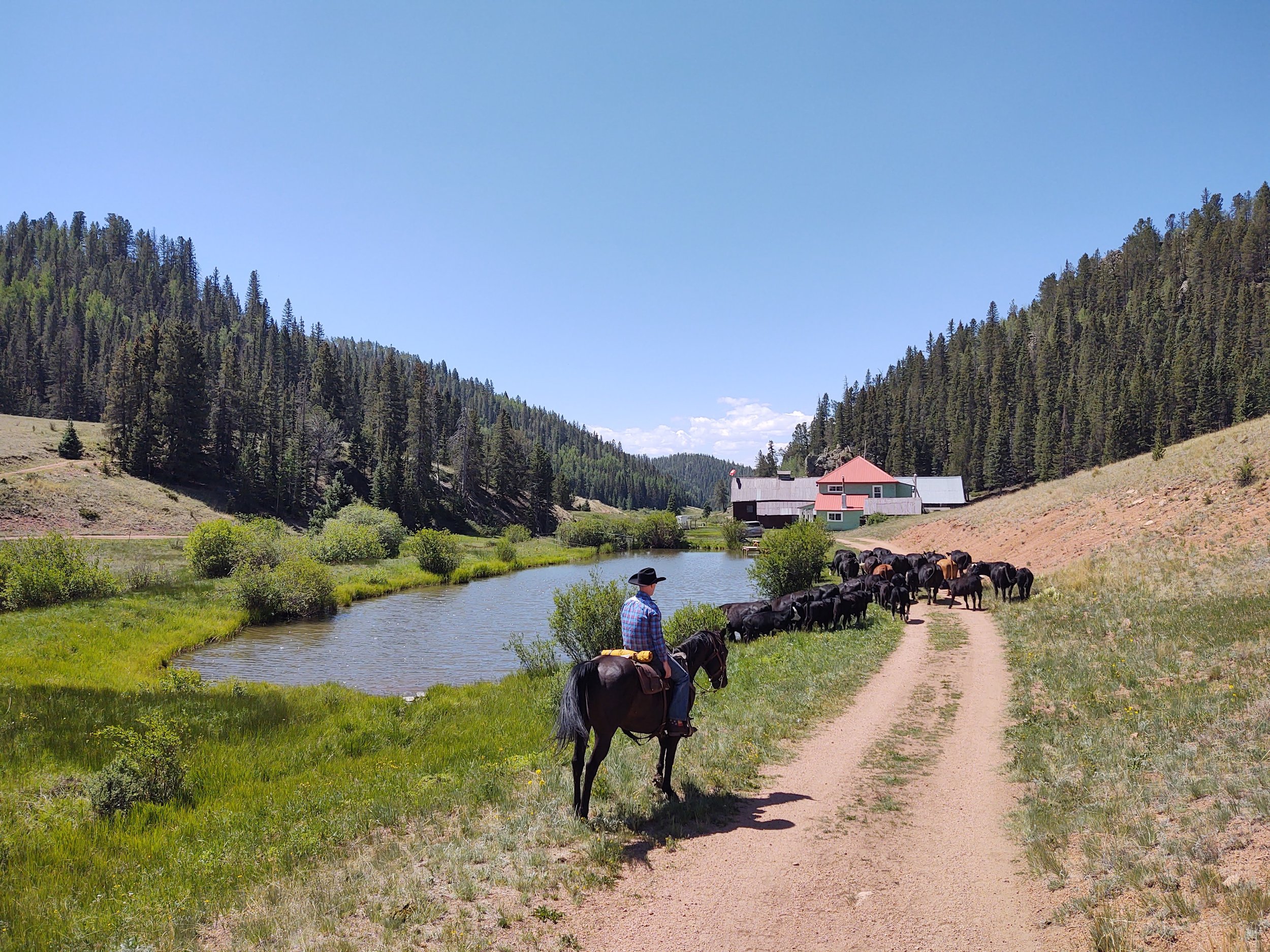
The advantage of hunting GMU 59 with Elk Glade is real and measurable: low hunter density on private ground, mature bull age structure, and Elk Glade’s 2,100 family-owned acres plus over 25,000 leased acres of cattle-managed, year-round-patterned country.

Read the unit profile for the full data sheet (terrain, draw odds, access points, weather) and the GMU 59 guide for the getting-started overview.
FAQ

Common questions.

What does OTC mean for Colorado elk hunting?

OTC stands for 'over-the-counter' — meaning the elk license can be purchased directly at any CPW agent or online without applying for the draw. Colorado has fewer OTC elk units than it did historically; many have moved to limited entry. The remaining OTC units tend to have higher hunter density.

Is limited entry better than OTC for elk?

Generally yes for hunt experience and success rate, but no for accessibility and planning flexibility. Limited entry units have lower hunter density, higher average bull age structure, and better success rates. OTC units are easier to plan around and don't require building points. The right choice depends on hunter situation, not absolute quality.

How many preference points do I need for a Colorado limited entry elk tag?

Depends on the unit and the season. Some easier limited-entry units draw with 0–1 points; popular units like GMU 59 may need 1–3 for non-residents; premium units (76, 201, 76) can take 6–10+ points. The CPW preference point calculator shows current cutoffs by unit, weapon, and season.

What's the success rate difference between OTC and limited entry?

Statewide bull elk success rates typically run 10–22% for OTC public-land hunters and 20–40%+ for limited entry, depending on the unit. Guided hunts on limited-entry private land run materially higher than that. The gap reflects hunter density, scouting time, and access concentration — not better elk biology in limited-entry units.

Can I hunt OTC elk on private land?

Yes, if you have permission, a lease, a landowner voucher, or you're booking through an outfitter that holds private-land access in an OTC unit. The combination — OTC tag plus private-land access — can be one of the highest-value plays in Colorado elk hunting because you skip both the draw friction and the public-land pressure.